
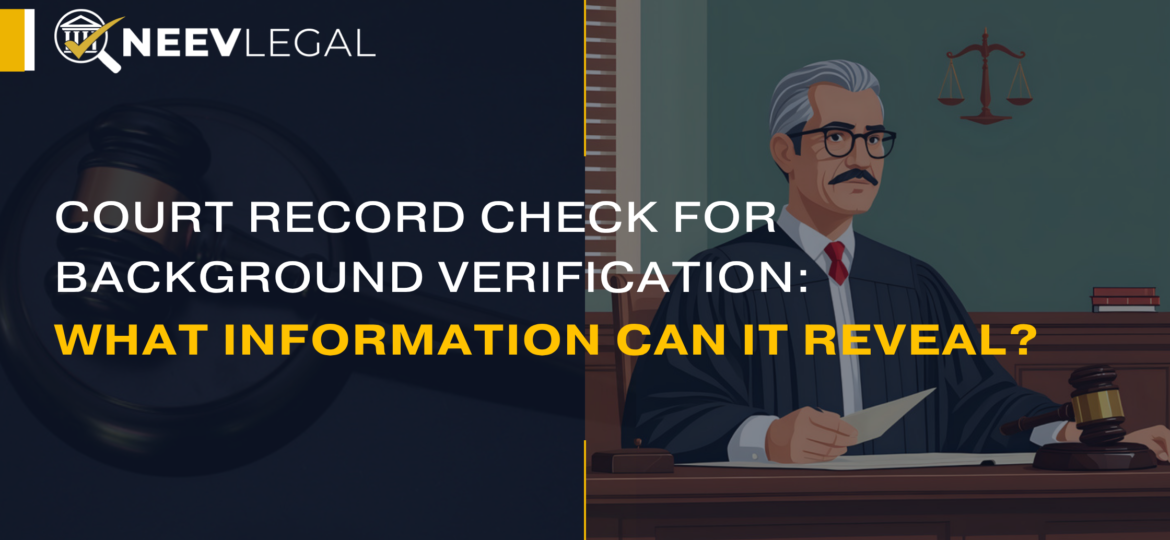
Employee Background Checks: What Court Records Can Reveal That a Resume Cannot
Employee Background Checks: What Court Records Can Reveal That a Resume Cannot
 Rizwan Mansoori
Employee Background Checks: What Court Records Can Reveal That a Resume Cannot
A resume tells you what a candidate wants you to believe. It lists degrees, job titles, and responsibilities, all curated and polished. It does not tell you who has a pending criminal trial, who is named in a cheque-bounce complaint, or who is fighting a civil dispute that could spill over into their work. That gap is where a background check court records search becomes one of the most underused tools an HR team has.
Most Indian HR teams run address verification, previous-employment checks, and maybe a police clearance. Very few pull litigation history. Yet court records are public, searchable, and frequently decisive. This article explains precisely what those records reveal, where they live, how a compliant search actually works, and why hiring without them is a measured risk most companies only notice after an incident.
If you need the practical endgame first: court verification at scale is a data problem, not a comfort problem, and the NeevLegal Court Record Verification platform exists so a compliance team can request and read structured litigation results instead of hunting through portals by hand. But let’s build the full picture before that.
The Resume Is a Forward-Looking Document; Court Records Are Backward-Looking Facts
Think about what a resume is optimized to do: present a narrative of capability. It is built for the interview, not for the background check. A candidate who spent two years defending a cheque-bounce matter under Section 138 of the Negotiable Instruments Act will not volunteer it, and it may have zero relevance to how they perform at work. The problem is you cannot know which past facts matter until you are aware they exist.
Court records solve this asymmetry. They are created by an institution, not by the candidate, so they carry a level of trustworthiness that a self-reported document never can. Even the strongest candidate typically has no objection to a litigation check once its purpose is explained, because honest people understand why financial firms and BFSI employers demand it.
The real value is not finding someone guilty of a crime. The value is finding something the candidate chose not to disclose, and then giving yourself the choice to evaluate it fairly.
What Court Records Actually Contain
In India, court records exist across three broad repositories, and they hold different kinds of information. The first is the criminal docket — the record of a person named as an accused in a criminal case, including the sections charged, the police station and FIR number, and the current status such as pending, acquitted, or convicted. The second is civil litigation, where a person may be a plaintiff, defendant, petitioner, or respondent in disputes over money, property, contracts, or family matters. The third is the outcome layer — orders, judgments, and hearing history.
For employment purposes, both criminal and civil records matter. A criminal record flagged during hiring matters for obvious reasons. But a person with a long line of unpaid-debt civil suits can present real risk to a role involving cash handling, collections, or financial decision-making.
Each type of entry carries specific identifying details. The most reliable is the CNR number, the unique national case identifier assigned by the eCourts system. A search that resolves a person’s identity to their cases — rather than just matching a name — is the difference between a useful report and a false match that wastes everyone’s time.
The Five Categories a Litigation Search Can Surface
When a structured court verification runs against a candidate, there are five categories worth understanding. Knowing them makes it far easier to interpret the result and decide what is relevant.
- Pending criminal proceedings. An active case where the individual is an accused. Relevance depends on the charge and the role you are hiring for.
- Convictions. A proven criminal record. This is the single most direct disqualifier for most regulated roles.
- Acquittals and discharges. Also worth seeing, because a discharge on merits is very different from an acquittal on a technicality, and an alert HR team knows the difference.
- Civil disputes. Money recovery suits, property disputes, and contract litigation. Frequently invisible to a naive check and frequently the more predictive signal for finance roles.
- Complaints and FIRs. Case records that reference the individual through an FIR or complaint number, even before a formal charge is framed. These are common in cheque-bounce and dowry provisions and can appear in a person’s history without any conviction.
The point of running the search is rarely to find a villain. It is to get a complete, honest picture so a human being can weigh the finding against the role.
Criminal vs Civil: Why Checking Both Changes Your Hiring Outcome
Many organizations believe a litigation check is just a criminal check. A standalone employee criminal record check is a necessary baseline, but it is not the complete picture a litigation search provides. That assumption quietly passes over one of the most common risk signals in Indian commercial life: civil liability. Consider a candidate for a relationship-manager position at a lending firm. A clean criminal record says nothing about the fact that they have been the defendant in five money-recovery suits. That pattern matters deeply for a role centered on other people’s deposits.
| Dimension | Criminal record | Civil litigation record |
|---|---|---|
| What it shows | Charges, FIRs, conviction, acquittal | Suits, petitions, respondent/defendant status |
| Where it appears | Criminal dockets, magistrate and sessions courts | Civil courts, tribunals, high courts |
| Typical employee relevance | Safety, trust, regulated roles | Financial discipline, contract behaviour |
| Most useful for | All employers, regulated BFSI, safety roles | Fintech, lending, collections, cash handling |
| False-match risk | Moderate — name-based duplicates common | Higher — more parties per case, more name collisions |
Both categories share one challenge: false matches. Indian courts carry enormous name duplication, especially in large cities and West Bengal, Kerala, and Tamil Nadu, where multiple people share identical common names and even similar fathers’ names. A usable check is therefore not the one that returns the most hits; it is the one that correctly attributes each hit to the actual candidate through identifiers like CNR, case number, court, and party role.
Where This Data Lives Online in India
Most of this information is public by design. The eCourts national portal is the entry point to case status for district and taluka courts across the country, and it publishes records such as cause lists, case status, and orders. The National Judicial Data Grid (NJDG) aggregates disposal and pendency data from the district judiciary and serves as the statistical backbone. The Supreme Court’s e-SCR platform publishes its judgments, and the high courts maintain their own judgment portals alongside.
The catch is access design. Each of these systems was built as a citizen tool, not as a data feed. Search is fragmented by jurisdiction, case filing patterns vary from state to state, and the terminology shifts across high courts. That is precisely why a background check court records operation in a large enterprise cannot be run by one analyst manually clicking through portals for every hire. It is a structured-data problem that needs a structured-data answer.
How a Court Record Search Works End to End
A defensible litigation search follows the same logic whether you run it manually or through an API, so it is worth walking through the steps once. First, the candidate’s identity is normalized: usually a name plus state, father’s or spouse’s name, and often the last known address. Second, that identity is matched against court dockets across the relevant jurisdictions. Third, each returned case is examined to determine the role the person plays in it — accused, plaintiff, respondent, or witness. Fourth, the status is read and categorized. Finally, the finding is written into a report with the source case numbers so it can be re-checked.
What separates a competent operation from a weak one is the middle of that process. A person’s name returning ten cases is not a finding. The finding is that candidate X is the first accused in case number Y, pending before the Additional Chief Metropolitan Magistrate in Bengaluru, charge sheeted under a specific provision. That is the level of detail an HR decision actually needs.
Consent, Law, and the Boundaries of What You Can Check
Court records are public, but collecting and using them about a candidate still sits inside a legal and ethical framework you should respect. Before running a check, obtain written consent from the candidate and explain what you are looking for and what you will do with the finding. This is standard for employee background verification and becomes a hard requirement as India’s Data Protection Board architecture under the DPDP Act, 2023 matures, because personal data must be processed for a legitimate purpose the individual has been told about.
Two practical rules keep you out of trouble. Do not run a litigation check on a candidate you have not invited into your process or without documenting consent. And do not treat a case listing as a verified fact about a person without confirming identity — naming a defendant in a civil suit may reflect a genuine dispute, or it may be a common-name collision, and both need different handling. A report that flags both the listing and the verification caveat is worth more than a blunt red or green verdict.
Reading a Hit: Suspicion, Proportion, and the Decision Framework
When a court record surfaces a hit, teams often panic into a binary response — hire or reject. A more useful posture is proportionality. Ask three questions about every finding: Is it genuinely this person? Is it relevant to this role? Is it consistent with what they told us?
Consider a candidate who disclosed nothing and is the complainant, not the accused, in a long-running property dispute. That is almost never a hiring risk. A candidate who omitted a pending cheque-bounce matter from a finance role is a different situation, because the omission itself signals the exact behaviour the role depends on guarding against. The evaluation is not mechanical, but it is predictable once you have a defined framework.
When Manual One-Off Searches Stop Working
A finance company hiring four people a month can reasonably task a compliance officer with manual portal checks. A staffing agency placing four thousand field workers a month cannot. At volume, three failure modes appear: throughput collapses because each jurisdiction is queried separately, consistency degrades because different analysts weigh findings differently, and documentation falters because capturing evidence from a portal into an audit trail is manual and error-prone.
This is the point where a structured background verification pipeline pays for itself. An API turns the entire search into a repeatable request, returns standardized fields instead of raw HTML, and logs each lookup so an auditor can trace how every decision was reached. For a BGV provider, a staffing firm, or an enterprise HR team running thousands of checks, that determinism is the difference between a process and a risk.
A Checklist for Building an Audit-Ready Screening Process
- Capture written candidate consent and a privacy notice before any check runs.
- Define what you check — criminal only, or criminal plus civil — and document the policy.
- Normalize identity data so searches match on more than a bare name.
- Require case-number-level detail on every finding, with the court and status included.
- Investigate common-name collisions before a hit affects a decision.
- Keep the raw source record so an auditor or candidate can re-verify it.
- Apply a documented proportionality framework, not an automatic reject rule.
- Re-check periodically for continuing roles, not just at point of hire.
An audit-ready process is one where a regulator, a recruiter, or a candidate can ask how a decision was made and you can answer with a traceable record. That single quality is what separates professional screening from improvised Googling.
Why Structured Litigation Data Wins for the Teams That Need It Most
Every fact above leans toward one conclusion. Court records are among the most valuable, least used inputs in Indian hiring because they cover exactly the ground a resume avoids. They are public, they are authoritative, and they are decisive in the situations where they matter most. The obstacle was never the data. It was the effort of extracting it cleanly at scale.
A Court Record Verification API removes that obstacle by returning litigation data as structured, attributable results your HR or BGV system can consume and store. If your checks are manual, the compliance officer still walks the same steps we described above — but if you are hiring at volume, or you need auditable evidence for BFSI or staffing compliance, an automated lookup is no longer a luxury.
The resume gives you a story. Court records give you a factual baseline against which to judge it. Good hiring decisions rest on having both.
Frequently Asked Questions
Is a background check court records search legal in India for employment?
Yes. Indian court records are public, and employers routinely verify litigation history for candidates with their consent as part of background verification. The legal boundary is not on accessing public court data; it is on how you collect and use a candidate’s personal data. India’s DPDP Act, 2023 requires consent and a stated purpose, so document both before running a check.
What is the difference between a criminal record check and a court record check?
A criminal record check focuses only on criminal proceedings — FIRs, charges, and convictions. A court record check is broader and also surfaces civil litigation such as money-recovery suits, property disputes, and company or contract matters. For finance and cash-handling roles the civil layer is often the more relevant signal.
Does an FIR appearing on a report mean the person is guilty?
No. An FIR records that an allegation was made and an investigation began; it is not a finding of guilt. Some FIRs never result in a charge sheet, and many are filed in cheque-bounce and family matters that end in settlement. Treat an FIR as a disclosure to evaluate with the candidate, not as a verdict.
Can a common name cause a false match in a litigation check?
Yes, and it is more common than most teams expect. Indian courts list many people with identical names, and civil cases can name multiple defendants with similar details. Any reliable check confirms identity through case numbers, the person’s role in the case, and identifiers such as CNR numbers before a hit is treated as belonging to the candidate.
Do I need the candidate’s consent to run a court record check?
Yes. Obtain written consent and disclose what you will check and what you will do with the findings. A clean consent trail is both an ethical practice and a compliance requirement as dataprotection obligations strengthen in India, so the consent record should sit inside your screening file.
How long does a court record verification take?
Manual portal searches can take days because each jurisdiction is queried separately. An automated lookup that normalizes identity and returns structured findings can deliver a result in hours. Time matters most for volumes driven by offer deadlines, and it is one reason hiring teams move from manual to API-driven checks.
What should HR do when a litigation hit looks serious?
Do not auto-reject on the first read. First confirm the case genuinely belongs to the candidate, then weigh whether it is relevant to the role, and check whether it was disclosed. Half the value of the search is giving the candidate the chance to explain. Document the reasoning so the decision survives internal or regulatory scrutiny.
Are civil disputes relevant to a background check?
They can be, depending on the role. A pattern of unpaid-debt or money-recovery suits is important for lending, collections, cash handling, and finance roles. For a purely technical role with no financial responsibility, a civil dispute may be irrelevant. That is why a defined relevance policy, not a blanket rule, is the professional approach.
How is identity confirmed in an online court record search?
Identity is confirmed by matching the candidate’s normalized details against the case parties and their identified roles using case numbers, the CNR number, the court, filing jurisdiction, and related party details. Simply matching a surname is not confirmation. Confirmation means the specific listed party can be tied to the specific candidate.
How often should litigation checks be repeated for existing employees?
For roles with ongoing fiduciary or safety responsibility, periodic re-checks — typically annually or on promotion into a sensitive role — make sense. Litigation status changes over time. A person clean at hire can become a party to a matter later, so a continuing check protects you in long-tenured, high-responsibility positions.
Can a court record check help with background verification of gig and field staff?
Yes, and it is becoming standard for platforms and staffing firms placing large numbers of workers. The challenge is volume, which makes manual checks impractical. A structured background check court records pipeline lets these teams screen thousands of candidates consistently rather than sampling a handful.
What does a good court verification report include?
A strong report includes the candidate’s normalized identity, the jurisdictions searched, every case found with its number and court, the person’s role in each case, the current status, and the source reference so it can be re-verified. Anything less is a name-hunt, not a finding.
NeevLegal provides automated, human-verified court record verification in India through a single API. If you are building an employee background verification workflow and need litigation data you can rely on, explore the NeevLegal Court Verification platform.
Related reading: